Subject Identification
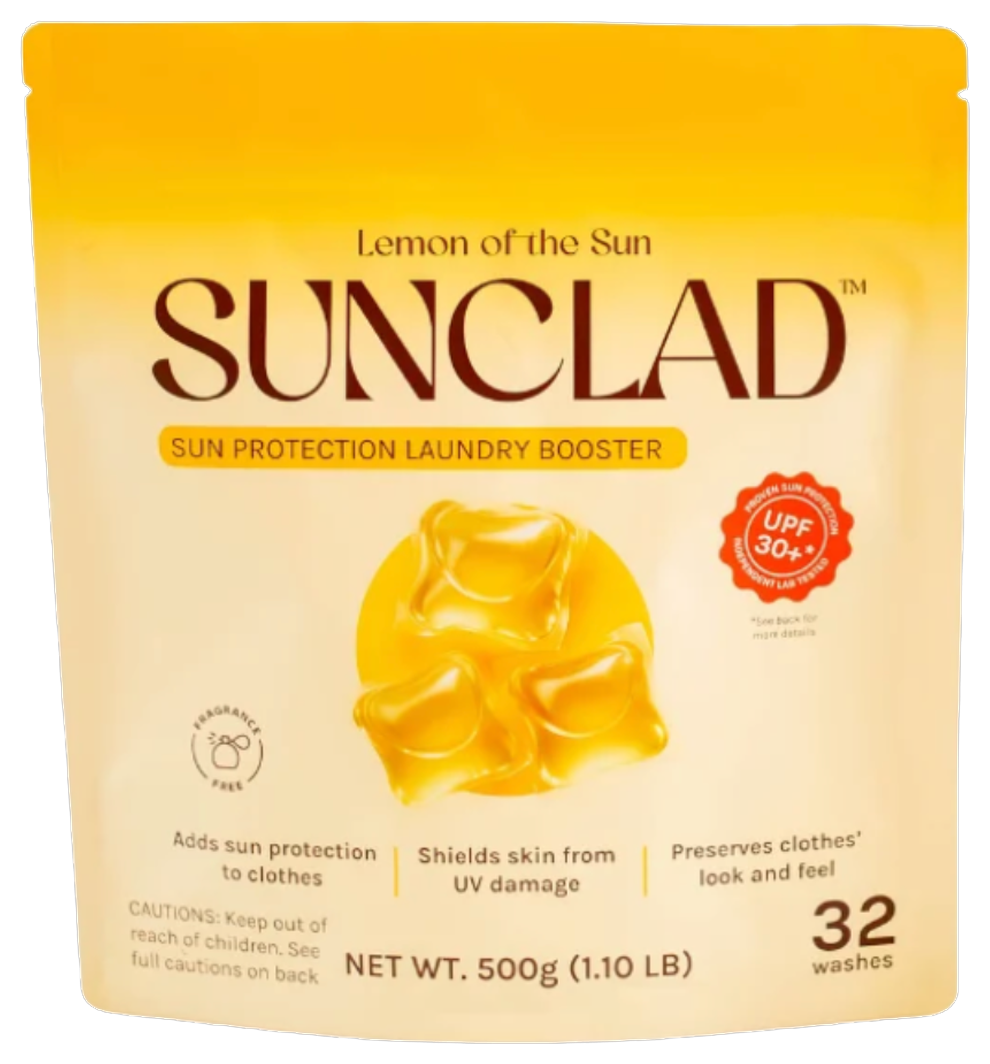
SunClad Sun Protection Laundry Booster
Verdict
"Three Bio Stars. Awarded for the best-documented wash-in sun protection on the market: independently measured, honestly reported fabric by fabric, and delivered through a chore that already happens."
A cotton sample entered third-party testing at UPF 4.5, which is to say it stopped almost nothing. One wash with a single SunClad pod took it to UPF 40.2. Three washes took it to UPF 50.7. Nothing was sewn in, sprayed on, or bought new. The Inspectorate records one correction to the received wisdom about this product, including its own earlier file. Wash-in ultraviolet protection is not a new category, and it is not a recent one. Ciba launched Tinosorb FD, an absorber designed to be carried into fabric by laundry detergent, in 1997, and a fabric softener version in 1999. An Australian detergent was selling on that claim by 2004. A Dutch additive has been on sale since about 2017 making the same UPF 30 to 50 plus promise SunClad makes. Rit Sun Guard, built on the same absorber chemistry, sits in American craft and hardware shops for under ten dollars and claims twenty washes of durability. SunClad did not invent this idea. It is at least the fourth consumer product to sell it, in a category almost thirty years old. What SunClad has done is document it better than anyone before it: independent laboratory measurement across three fabrics and three wash stages with the whole table published, including the blend that only reached 27, the test standards named, all seven ingredients declared including the absorber class, four named dermatologists on the record, and a measured result on cotton well above what the incumbent claims. That is the case for the award. Against it sit the open items, which are real: durability is claimed at three washes where the incumbent claims twenty, at five times the price; the laboratory engagement is named but no report number or date is published, so no reader can confirm it; the absorber is declared only by chemical class while the marketing calls it proprietary; and no dermal safety or environmental fate data exists for the finished formulation. The Inspectorate found no stiffness, no residue, no scent and no change in drape or colour across a season of ordinary laundry, and continues to use it.

BIO-STARRED
VOL. I · MMXXVI–MMXXVII
13-Circle Assessment
Inspector Notes
“I have a family history of skin cancer, which means I have spent my adult life being told to put sunscreen on skin that is underneath a shirt. I have never once done it. Nobody does. The other answer, UPF clothing, has always looked like it was designed by someone who resented being outside. So I came to SunClad already wanting it to work, and I want that bias on the record before I describe what happened.
“The pouch is small and yellow and lives next to the detergent. The pods are the size of a dishwasher tablet. You put one in the drum with your normal detergent and your normal clothes and start the machine. That is the entire user experience. I washed a white cotton poplin shirt, two pairs of linen trousers, a black cotton dress, and the stack of T-shirts I wear on the water. I washed them three times over two weeks, because the brand says the protection builds, and I wanted the full effect before I judged anything.
“Then I went looking for the failure before I went looking for the benefit. A coating. A waxiness. A film. Stiffness through the cotton. A linen shirt that no longer moved like linen. A smell. A residue. Anything at all announcing that chemistry had just been deposited on something I was about to put against my skin. I smelled it. I rubbed the cotton between my fingers. I held it to the light. I checked the drape. The white shirt stayed white, the black dress stayed black, the linen felt like linen, and if you had handed me a treated shirt and an untreated one I could not have told you which was which. That is the entire achievement. Sun protection you cannot detect is sun protection you will actually use.
“What I could not measure at a kitchen table is the thing that matters, so I read the testing instead. Lemon of the Sun commissioned TÜV SÜD, which is a serious independent laboratory, to measure ultraviolet transmission through three fabrics before treatment and after one, two, and three washes. One sample started at UPF 4.5. That is a fabric that stops essentially nothing. After one wash it measured 40.2. After three, 50.7. A second sample went from 14.7 to 50.5. A third went from 5.4 to only 27.0.
“That third number is the most important one in the file, and the brand prints it right next to the good ones. It is the proof that this is chemistry and not magic. Fibre matters. Weave matters. Construction matters. A treated open-weave shirt still has physical holes in it, and no absorber can fill a hole. The brand says plainly that polyester and nylon barely respond, that results vary with fabric and washing conditions, that this is not a detergent, and that you should keep wearing sunscreen on your face and hands. It argues against its own overreach three separate times on one product page. That is the moment I trusted them.
“Four board-certified dermatologists recommend it on the record with no financial disclosure, and one of them founded a UPF apparel company and still says this is the better answer for the clothes people actually own. That is not a small thing for a competitor to say out loud.
“Then there is the part I keep thinking about, which is my closet. Look in yours. Almost nothing in it was bought as protective equipment. The white T-shirt. The linen button-down. The cotton dress. The clothes we reach for precisely because the sun is out are not the clothes engineered to handle it, and a lightweight shirt is not meaningful protection simply because there is skin underneath it. SunClad looked at that gap and did not design another shirt. It redesigned the wash.
“What is missing is the back office of a very young company. Where the ingredients come from. The factory's records. What the formulation does once it is in the water system, which for a wash-in product is a fair question and currently an unanswered one. A carbon figure. I have scored those honestly and said so in each note, and they are the paperwork this file is waiting for. Not one of them touches the chemistry or the result.
“I expected to give this a good mark. I did not expect to still be using it months after the audit closed, and I am. Every load.
“One correction I owe the record, because I got it wrong the first time. I said there was no other product like this on the market. There is, and there has been for a very long time. The chemistry that makes this work was launched by Ciba as a detergent ingredient in 1997 and as a fabric softener ingredient two years later. An Australian detergent was selling sun protection on it by 2004. A Dutch wash-in has been on sale since around 2017 promising exactly what SunClad promises. And Rit has sold a wash-in sun protectant for years, built on the same class of absorber, which you can buy at a craft shop for under ten dollars, claiming UPF 30 on a white shirt and about twenty washes of durability. SunClad is not the first. It is somewhere around the fourth, in a category almost thirty years old.
“So what is SunClad actually for. It is not the first. It is the best documented by a distance, and that turns out to be the whole argument. The Dutch product will not tell you what is in it or how long it lasts. The Australian claim I could only ever find in a magazine, never in anything the manufacturer published, and it was gone from their own site by 2014. Rit gives you one number. SunClad commissioned an independent laboratory, named the standard it tested to, ran three different fabrics across three washes, and published the whole table including the blend that only got to 27. It names all seven of its ingredients, including the one that does the work. Four dermatologists put their names to it. And on cotton it measured well past 50, a long way above what the incumbent claims. I would still buy it. I would also want to know the cheaper option exists before I did. So now you do.
“Two things I have to correct in my own file, because I published them wrong. I said the brand names no test standard. It does: the product page says the testing was done to AATCC TM183:2020e, which is the actual standard method for measuring UV through fabric, with ISO 6330 for the washing. That is to their credit and I removed it in error. What they do not cite is ASTM D6603 and D6544, the American route to putting UV protective on a label, which makes you launder the fabric forty times and age it under lamps and chlorine first. Their data stops at three washes.
“And I implied their chemistry might be hard on waterways. Having now identified the substance and read the regulatory file on it, that was unfair and I am correcting it. Testing on fish, water fleas, algae and the bacteria in sewage treatment found no toxicity at the highest concentrations tried. It is not a skin sensitiser. Its chemistry means it cannot really get through the outer layer of skin, and the closest relative anyone has studied properly came back clean across human patch testing in three hundred people. It sits on no European restriction list. What is genuinely still open is narrower: nobody has tested it for ready biodegradability, only a weaker standard, and about a quarter of what you put in the machine leaves in the wastewater instead of sticking to your clothes. So the brand saying flatly that every ingredient is environmentally friendly still reaches further than the evidence. But the evidence is more reassuring than I made it sound, and that is my error to fix.
“One last thing, and it is a small thing that matters in a file about honesty. The site introduces one of its four dermatologists as an M.D. The federal registry lists her as a D.O., in a town one word different from the one printed. None of the four testimonials says whether the doctor was given anything, while the same website has a page inviting dermatologists to earn commission on what they sell. I found nothing suggesting any of these four took a penny. But if you are going to build a brand on dermatologists vouching for you, the disclosures and the credentials have to be exactly right, and right now they are not.
“One more thing that sits badly with me. They call the technology proprietary and the product patent-pending, and then they print the active on the ingredient panel, where it turns out to be a material industrial suppliers advertise as equivalent to that 1997 Ciba product and publish the dosing charts for. Both of those things cannot be doing the work they look like they are doing. I could not read the patent application, so I am not saying there is nothing in it. I am saying that if the clever part is the pod or the dose, say so, because the absorber is not the clever part and their own panel already admits as much. Telling people what is actually in the bottle is the more impressive move anyway, and almost nobody else in this category does it.
“Something I did not understand until I went looking, and I think most people do not. The standards behind sun protective clothing only measure one thing: how much ultraviolet gets through the cloth. None of them, not the American ones, not the European one, not the Australian one, asks a single question about what chemical you used to get there or whether it is safe against skin. So when a brand in this category tells you it was independently tested to a standard, believe the number and do not read anything into it about safety, because the standard never looked. SunClad names its standard and names its ingredients, which is more than its competitors do, and I still had to go to the European chemicals registers myself to find out that the active is not classified as a skin sensitiser and is not restricted anywhere. That is a gap in the category, not in this product.”
— Inspector 7
13-Circle Findings
Circle by Circle.
I · Core Integrity
Pass
The central claim is specific, bounded, and supported by third-party instrumental testing: treatment raises the measured ultraviolet protection factor of compatible textiles. The brand states where the treatment underperforms, publishes its weakest result beside its strongest, and tells customers to keep using sunscreen on exposed skin. The one discipline required is precision. A result obtained from a specific sample under a specific wash protocol is not a guarantee that every garment reaches the same number.
II · Efficacy
Pass
Independent laboratory testing commissioned from TÜV SÜD measured ultraviolet transmission before and after treatment on three fabrics across three washes, and the brand names its method: AATCC TM183:2020e with ISO 6330 laundering. The strongest sample moved from UPF 4.5 to 40.2 after one wash and 50.7 after three. The weakest moved from 5.4 to 27.0. Publishing the weak result beside the strong ones is the file's clearest signal of good faith. Two qualifications belong beside it. The weakest fabric never reaches UPF 30, while the headline claim across the site is UPF 30 to 50 plus. And the method named is the measurement standard, not ASTM D6603 and D6544, the American labelling route, which requires forty launderings plus light and chlorine ageing before a garment may be labelled UV protective.
III · Physiological Alignment
Pass
The product acts on a barrier the wearer has already chosen to put on, rather than asking for a second intervention on skin that is already covered. It reduces the ultraviolet dose reaching the dermis, which is the most established photoprotective principle there is. Nothing is absorbed, ingested, or applied to the body.
IV · Regulation & Recovery
Pass
There is no stimulation, no injury, and no recovery. The mechanism is preventative: the fabric transmits less ultraviolet radiation than it did before. Nothing is asked of the body, and nothing needs to heal.
V · Input Quality
Partial
Seven ingredients are named on the pouch and the product page, one of which does the work: a triazine acid sulfonic derivative, the established class of wash-in textile ultraviolet absorber. The Inspectorate identified the class with confidence, a disodium sulfonated stilbene-bis-triazine, the chemistry behind the commercial product Tinosorb FD, and reviewed the regulatory toxicology on it. That record is reassuring on the question that matters most for a garment worn against skin: the substance was not a sensitiser in guinea pig maximisation testing, its partition coefficient predicts negligible dermal absorption, and the assessing authority found no evidence of loss from washing or drying nor bleeding from treated fabric in wear. What SunClad itself has not published is the specific identity of its absorber, its CAS number, or its concentration.
VI · Environmental Quality
Pass
The product is fragrance-free and dye-free and the treated garment is meant to be indistinguishable from an untreated one. Across a season of ordinary laundry the Inspectorate found no stiffness, no film, no residue, no scent, and no colour change on white cotton, black cotton, or linen. The sensory achievement is absence.
VII · Operational Precision
Pass
A pre-measured water-soluble pod removes the dosing variable entirely. The laboratory results were produced under a stated protocol: a 2.5 kilogram load, standard consumer detergent, one pod, a 60 degree gentle cycle of 41 minutes, tumble dried. Publishing the protocol is what makes the numbers assessable, and it lets a reader tell laboratory performance from a home result.
VIII · Care & Competence
Pass
The brand does not ask to replace anything. It tells customers to keep applying sunscreen to exposed skin, tells them the treatment does little for polyester and nylon, and tells them it is not a detergent. Four board-certified dermatologists recommend it on the record. The Inspectorate records three findings on those endorsements. One is described on the site as an M.D. and is listed in the federal practitioner registry as a D.O., with the practice town also misstated. Two of the four have their own sun-care ventures, one disclosed inside her own testimonial and one not disclosed on the site at all. And no material connection is disclosed for any of them while the company runs a published programme recruiting dermatologists on commission.
IX · Protocol Design
Pass
The strongest Circle on the file. The protocol is one pod in the drum with the detergent already going in. There is no dose to measure, no sequence to learn, no step to skip, and no decision to make while getting dressed. The intervention rides on a chore that was happening anyway, which is why the Inspectorate expects adherence where every other photoprotective habit fails.
X · Aesthetic Restraint
Pass
The technology is invisible in wear. Nobody has to replace a wardrobe with a technical one, and nothing about the garment announces that it has been treated. SunClad's aesthetic achievement is preservation. The shirt stays the shirt.
XI · Stewardship
Partial
Treating clothes already in circulation rather than manufacturing a protective wardrobe is a plausible material advantage, and a dissolving pod in a resealable pouch is close to minimum packaging. The regulatory record on this class of absorber is better than the file previously implied: acute aquatic toxicity testing on fish, water fleas and algae returned no effect at the highest concentration tested, which is a low-toxicity result. What has never been established is ready biodegradability. The substance was assessed only as inherently biodegradable, which is a weaker standard, with a measurable fraction binding to sludge. Against that record the brand's unqualified statement that every ingredient has been studied and shown to be environmentally friendly is not supported, and the brand's own homepage hedges it to designed to be safe.
XII · Cultural Responsibility
Partial
The product adds photoprotection without prescribing an aesthetic, a dress code, or a specialist wardrobe, which makes it compatible with a far wider range of personal, cultural, and climatic clothing than UPF apparel has ever been. Manufacturing location, labour conditions, and full supply-chain provenance were not sufficiently documented to close the Circle.
XIII · Enduring Value
Pass
The problem is permanent. Skin will keep needing protection and ordinary clothing will keep varying enormously in how much it provides. What the Inspectorate cannot credit is novelty: wash-in ultraviolet protection has been commercially available for years and the incumbent product claims longer durability at a fraction of the price. SunClad's durable contribution is documentation rather than invention, and the behavioural architecture, protection folded into a chore that already happens, which is the part most likely to still be working in a decade.
The Record
What was examined.
Mechanism
SunClad is a laundry additive built around a triazine acid sulfonic derivative, a class of ultraviolet absorber that bonds to the hydroxyl groups of cellulose during the wash. Once associated with the fibre it absorbs UVA and UVB before that radiation can pass through the fabric to the skin. The approach is established textile science. The distinction is the delivery: the same chemistry normally finished into a garment at the mill is introduced at home, in a machine the household already runs.
Third-party testing
Lemon of the Sun commissioned ultraviolet transmission testing from TÜV SÜD, an independent certification body, on three fabrics measured untreated and after one, two and three SunClad washes. The brand states the work was carried out in accordance with AATCC TM183:2020e, the standard method for measuring erythemally weighted ultraviolet transmission through fabric, with ISO 6330 domestic laundering. The reported conditions are a 2.5 kilogram load, standard consumer detergent, one pod, a 60 degree gentle cycle of 41 minutes, tumble dried, measured on a spectrophotometer. Two gaps remain. No report number, certificate identifier or date is published, so the engagement cannot be verified from outside. And the American labelling route for UV-protective textiles, ASTM D6603 with the D6544 ageing practice, is not cited; that route requires forty launderings plus simulated sunlight and chlorinated water before a fabric may carry a UV-protective label, where this data stops at three washes.
The three samples
Sample one: UPF 4.5 untreated, 40.2 after one wash, 42.2 after two, 50.7 after three. Sample two: 5.4 untreated, 16.7, 21.5, 27.0. Sample three: 14.7 untreated, 34.3, 42.0, 50.5. Every sample rose substantially. Only two of the three crossed 50. The most impressive number in the file is 50.7, and the most important fact in the file is that one sample did not get near it. The brand publishes the weak result beside the strong ones, which is the single strongest signal of good faith in this record.
What UPF actually measures
UPF describes how much ultraviolet radiation a textile lets through. A fabric at UPF 50 transmits roughly one fiftieth, about two percent, of the relevant radiation under test conditions. Higher is better. But a real garment is governed by more than its chemistry: fibre, construction, weave density, thickness, colour, stretch, moisture, and fit all move the number. Chemistry cannot close a physical gap between threads, which is why a treated open-weave shirt is not the equivalent of a purpose-built UPF 50 garment.
Textile compatibility
The brand reports the greatest effect on natural fibres and compatible blends, with cotton and linen the best responders, and states that the treatment is minimally effective on fully synthetic fabrics such as 100 percent polyester and nylon. Loose mesh and open weaves stay limited for the physical reason above. SunClad treats fibres. It does not redesign the garment.
Formula
Seven ingredients are declared: primary alcohol ethoxylate, the triazine acid sulfonic derivative that does the work, alcohol ethoxylate, sodium laureth sulfate, propylene glycol, glycerin, and phenoxyethanol. The product is marketed as fragrance-free, dye-free, paraben-free, and PFAS-free. The institution treats those as accurate ingredient statements and does not extend them into conclusions about environmental fate.
Durability
The brand reports that the added protection persists through at least three subsequent washes without another pod, and recommends continued use to build and maintain it. The Inspectorate found no published data beyond that window. Three washes is a useful figure. Thirty would say something else entirely.
Standard of care
Sun-protective clothing is one component of ultraviolet protection, not the whole of it. Treated clothing protects the skin it covers and nothing else. Exposed skin still needs sunscreen, shade, and timing, and the brand says so itself on the product page. SunClad is most accurately understood not as a replacement for photoprotection but as a way of raising the protective value of clothes a person already owns and already wears.
The category, and how old it is
Wash-in ultraviolet protection has a longer history than any party to this file first assumed. Ciba Specialty Chemicals launched Tinosorb FD, an absorber intended to be delivered to fabric through laundry detergent, in 1997, and Tinosorb FR for fabric softeners in 1999. Trade coverage at the time recorded the industry's hesitation in a line worth preserving: detergents remove things from clothing, and it is a stretch to use them to put something on. By December 2004 an Australian detergent, Radiant 3 in 1 Colour Care, was being sold on a Tinosorb FD sun protection claim reported as blocking at least 96 percent of ultraviolet radiation. That figure is attested by contemporaneous press rather than by any manufacturer document the Inspectorate could retrieve, and the claim had disappeared from the brand's own materials by 2014. A Dutch additive, UVwash from YOU and UV, has been on sale since about 2017, states it was tested by the University of Groningen and by SGS, and claims to take an ordinary shirt from UPF 5 to 25 up to UPF 30 to 50 plus after a single wash. That is the same claim SunClad makes. It names no active ingredient and no durability figure, and sells at about twenty three euros for 250 millilitres. There is also evidence, which the Inspectorate could not confirm from a primary source and records as unconfirmed, that the Skin Cancer Foundation once ran a seal category specifically for ultraviolet fabric treatments applied through the laundry process. The conclusion drawn here is not that SunClad is derivative. It is that SunClad is a late entrant to a category almost thirty years old, and that its claim on this institution's attention rests on execution and evidence rather than on invention.
The incumbent
Wash-in ultraviolet protection is not new. Rit Sun Guard, a powder laundry additive built on Tinosorb FD, a triazine sulfonic acid UV absorber of the same chemical class SunClad declares, has been sold in the United States for years and remains on sale at national craft and hardware retailers for under ten dollars. Its published claims are UPF 30 on a white cotton shirt, blocking more than 96 percent of ultraviolet radiation, added to a warm or hot wash with ordinary detergent, and lasting up to twenty washes. The Inspectorate records three differences in SunClad's favour: independent per-fabric testing published in full rather than a single headline figure, a measured result on cotton well above UPF 30, and complete ingredient disclosure. It records one against: a durability claim of three washes against the incumbent's twenty, at five times the price.
Proprietary, and what that word can carry
The site describes the active as proprietary ultraviolet protection technology and the product as patent-pending. The ingredient panel names the active as a triazine acid sulfonic derivative. Those two statements sit oddly together, because that description matches a commodity material. At least one industrial supplier sells a triazine sulfonic acid derivative expressly marketed as equivalent to Tinosorb FD, with published dosing recommendations for concentrated detergent, ordinary detergent and liquid detergent, and states it can be dry-mixed or agglomerated into laundry products. The Inspectorate could not read the patent application, because the patent database was unavailable throughout the audit, and it draws no conclusion about what may be claimed in it. What it records is narrower. The absorber chemistry is not proprietary to this company and has been available to formulators for nearly thirty years. Whatever is genuinely novel lies in the pod, the dose, or the delivery, and the brand has not said which. Calling the absorber proprietary overstates the position. Declaring it on the panel, which the brand does and most of its competitors do not, understates nothing.
The chemistry, in context
SunClad declares a triazine acid sulfonic derivative as its active. The Inspectorate identified the class with confidence as a disodium sulfonated stilbene-bis-triazine, the chemistry commercialised as Tinosorb FD, an anionic compound with high affinity for cotton that absorbs across UVA and UVB and accumulates with repeated washing. The published regulatory toxicology on this substance is more reassuring than the file previously suggested. It was not a skin sensitiser in guinea pig maximisation testing. Its partition coefficient predicts negligible dermal absorption. The assessing authority found no evidence of loss from washing or drying, and no bleeding from treated fabric in wear. In concentrated form it is a serious eye irritant, which is a handling matter for the undiluted material rather than a wearing matter. On the environment, acute toxicity to fish, water fleas and algae showed no effect at the highest concentration tested. The substance has never been tested for ready biodegradability; it was assessed only as inherently biodegradable, with a measurable fraction adsorbing to sludge. SunClad has not published its own absorber's identity, CAS number or concentration, so all of this is class-level information.
The endorsements
Four board-certified dermatologists recommend the product on the record, three on the product page and a fourth on the homepage only. Three findings. The site presents one as Dr Jackie Levin, M.D., of West Dermatology in Santa Margarita, California; the federal practitioner registry lists Jacqueline Levin as a D.O. practising dermatology in Rancho Santa Margarita. The credential and the town are both misstated, which is the brand's copy rather than the physician's doing, and should be corrected. Two of the four have their own sun-care ventures: one founded a UPF apparel brand and volunteers that inside her own testimonial, and one co-founded a sun care brand which is disclosed in trade press but not on this site. And no material connection of any kind is disclosed alongside any testimonial, while the company publishes a programme inviting dermatologists to earn commission on sales through their own links. The Inspectorate found no evidence that any of the four is enrolled in that programme or has been paid. It records that the absence of a disclosure is not the same as the absence of a relationship, and that American endorsement rules require a material connection, including free product, to be disclosed.
How the claims have changed
The product was renamed three times before launch and its claims were materially softened. Archived captures of the site show it marketed in September 2024 as anti-aging armor, and in January 2025 with the claim that it was shielding you from skin cancer and premature aging. Both the disease-prevention claim and the anti-ageing claim were removed before the April 2026 launch, and the current copy is confined to ultraviolet protection. The Inspectorate regards the removal as the right correction, made before the product reached market, and records it because a file about advertising discipline should show the direction of travel as well as the present state.
What the regulators have concluded
The absorber carries a harmonised European classification under the CLP Regulation at index 613-262-00-1: serious eye damage, hazard statement H318, and nothing else. No skin sensitisation, no carcinogenicity, mutagenicity or reproductive toxicity, no aquatic hazard classification. The eye classification attaches to the concentrated raw material and is a handling matter for manufacturing rather than a wearing matter; at in-use concentrations the finished detergent is not classified as hazardous. Beyond that the substance appears on no European authorisation list and no restriction list, and the Inspectorate located no candidate-list entry. It is registered under the European chemicals regime. In the assessing authority's words it is practically non-toxic to fish, aquatic invertebrates, algae and aerobic bacteria under acute exposure. Two pieces of context belong beside that. Europe does prohibit one ultraviolet absorber in textile articles with no clothing exemption, UV-328, under the Persistent Organic Pollutants Regulation; it belongs to the benzotriazole family and is a different chemistry from this one. And OEKO-TEX Standard 100, the most widely recognised textile safety certification, restricts six benzotriazole ultraviolet stabilisers by name and does not address this class at all, which is silence rather than approval. Set against the brand's unqualified statement that every ingredient has been shown to be environmentally friendly, the fair summary is unchanged: the acute safety record is good, the biodegradability record is incomplete, and the claim is written more broadly than either supports.
What the test standards do not cover
A point of clarity buyers of anything in this category deserve. The four standards that govern sun-protective textiles worldwide, AATCC TM183 in the United States, ASTM D6603 for labelling, EN 13758 in Europe and AS/NZS 4399 in Australia and New Zealand, measure or classify exactly one thing between them: how much ultraviolet radiation passes through the fabric. Not one imposes any chemical or skin-safety requirement on whatever produced that result. A fabric can be tested to AATCC TM183 and labelled to ASTM D6603 with no assessment whatever of the substance applied to it. So the TÜV SÜD engagement SunClad cites is the right test, correctly named, and it proves precisely what it proves, which is transmission, and nothing at all about safety. The safety case for this product rests entirely on the regulatory record of the absorber class set out above and on the brand's ingredient disclosure. That is not a criticism of SunClad. It is a correction to the way this whole category is usually read, including by this institution's own earlier file.
The Reading Room
Inside the Unredacted File.
The full 13-Circle rubric. The Inspector's complete notes. The Evidence behind every finding. Filed inside the Membership.
Apply for Membership →Continue the Archive