Subject Identification
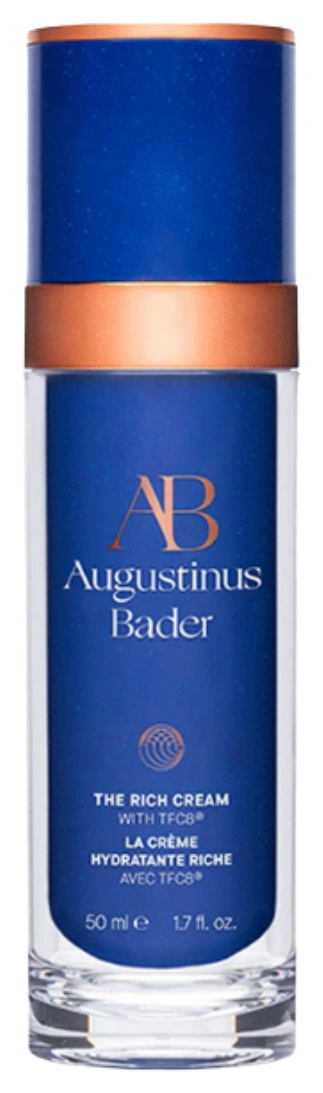
Augustinus Bader The Rich Cream
Verdict
"One Bio Star, by founder's ruling. The institutional score of 3.51 clears the One Bio Star threshold outright; the Floor Principle held the anchors at Finalist, with Stewardship at 2.71 on absent environmental disclosure rather than on any finding about the cream, and Efficacy at 2.86 on the absence of a published effect size and a vehicle arm. Recognised for the best-built emollient base examined in this volume, a tolerance record better than anything else in active skincare, and a scientific principal who disclosed more in his patents than his marketing has ever claimed. The ruling covers documentation; no score was moved."
Somewhere between the laboratory and the jar, the most interesting thing about this product stopped being mentioned. The patents describe an engineered growth-factor variant tethered to a sugar polymer, an erythropoietin-receptor agonist paired with its own antagonist, and two collagen matrikines. The label describes provitamin B5, arginine and phenylalanine. Both documents are truthful, and the patent itself explains why: it defines the trigger factor as vitamin B5 or those amino acids. So the technology really is in the jar, and it is humbler than the story. Meanwhile a blinded controlled study and a proper patch test sit unread inside patent filings while the website publishes two study descriptions that do not agree. This is a brand that owns more rigour than it publishes. One study would settle the whole question, and no one in prestige skincare has ever run it: the same cream, twice, with the complex left out of one.

BIO-STARRED
VOL. I · MMXXVI–MMXXVII
13-Circle Assessment
Inspector Notes
“I want to begin with the part I did not expect, because it is not the science and it is not the price.
“It is very good. The first morning I assumed I was flattering it, so I kept using it and kept a note each day, and four weeks later the note says the same thing it said on day two. The texture is the achievement. Rich creams in this bracket are usually either heavy enough to sit on the skin until morning or so aerated that nothing is left an hour later. This one does neither. It picks up cleanly on a fingertip, spreads without dragging, needs no warming between the palms, and absorbs to nothing while leaving the skin measurably softer at breakfast. I never once applied too much. I am not sure I have written that sentence about any other cream.
“Look at why. Coco-caprylate and caprate, sunflower seed oil, squalane, argan, ethyl oleate, avocado, evening primrose, shea. That is a deliberate fatty-acid spread, emulsified on polyglyceryl-4 and polyglyceryl-6 oleate rather than PEGs, carried with tocopherol and zinc PCA. Somebody who understands barrier lipids built this and was given the budget to build it properly. An overnight improvement in skin is exactly what a lipid system of that quality produces, and there is no mystery in it and no shame in it either.
“Then I read the patents, and that is where the file turned.
“I had expected the usual thing, which is a trademark with very little underneath it. That is not what is there. What is there is an engineered TGF-beta 3 variant with three named point mutations, tethered through a sortase motif to a trehalose glycopolymer. An erythropoietin-receptor agonist deliberately paired with its own antagonist, which is a subtle piece of design and not something anyone does by accident. A DPP4 inhibition module. Two collagen-fragment matrikines. Four complete worked examples. Sequence listings. This is a real scientist's notebook, and the erythropoietin module runs straight back to his own published academic work.
“And then I read the ingredient list again, and the two documents will not meet.
“None of those modules is on the label. What is on the label, down at the bottom where things below one percent are required to sit, is alanyl glutamine, arginine, oligopeptide-177, phenylalanine and palmitoyl tripeptide-8. I went back to the claims to see whether I had missed something, and instead the patent answered me directly. Its own language says the triggering agent is choline, vitamin B5, or arginine, phenylalanine and citrulline. The cream has panthenol at position eleven. Arginine at twenty-seven. Phenylalanine at twenty-nine.
“So the trigger factor is genuinely in there, exactly as claimed. And by the inventor's own definition, it is provitamin B5 and two amino acids.
“I sat with that for a while, because I could feel myself wanting it to be a scandal and it is not one. Nothing is missing that the patent requires. Nothing on the label is false. The formula is consistent with its own intellectual property. What is true is only this: the thing doing the work at the bottom of the list is not the thing the story is about, and the customer is never given what they would need to tell the difference.
“The other discovery cuts the same way. I found a blinded one-month controlled study with a real imaging platform, a real comparator and a real seasonal control, and a repeat-insult patch test in thirty subjects read at three intervals against international guidelines. I found both of them inside patent specifications. Not one consumer page mentions either. Meanwhile the product page says thirty subjects over four weeks and the help centre says ninety over twenty-eight days, and no reader can tell whether those are two studies or one badly described. This is a brand that owns more rigour than it publishes and publishes numbers it has not reconciled. That is a rare failure and it is still a failure.
“And the comparator in that patent study was dexpanthenol at five percent. Panthenol is ingredient eleven in the cream. I do not think the brand has ever noticed that its own control is in its own formula.
“On the burn trial, since it will come up. The principal ran a randomised controlled trial of topical erythropoietin in burn wounds, it stopped early, and the primary endpoint came out significantly in favour of placebo. That is about as unflattering as a result gets. It is also a different molecule, a different route and a different indication, in injured skin rather than intact skin, and it tells us nothing about whether a cream improves the look of a healthy face. What it does tell us is that when this scientist got an answer he did not want, he published it. I would rather audit that person than the alternative.
“So where does that leave me. It leaves me with a cream I will keep using, which is not a sentence I write often, and with one experiment I cannot stop thinking about. Make the same cream twice. Leave the complex out of one. Do not tell anyone which is which. Nobody has ever run it, here or anywhere else in prestige skincare, and until somebody does, every claim in this category rests on the base rather than the active and no one can prove otherwise.
“If Augustinus Bader ran that trial and the complex won, it would be the only brand in the category that could say so. That is a Star sitting in plain sight, and it costs one study. Until then the Star stands by ruling: examined all the way through, recognised for what is in the jar, and held short of a Star on the anchors by documents the brand has not published and one experiment nobody has run.”
— Inspector 7
13-Circle Findings
Circle by Circle.
I · Core Integrity
Pass
Pass throughout, narrowly in three places. The scientific principal is a sitting university chair named on the patents, nothing claimed is false, and no disease claim is made anywhere. What the file records is the distance between what is said and what is implied, and one specific inconsistency: two different descriptions of the supporting study, thirty subjects over four weeks and ninety over twenty-eight days, offered as evidence for the same product.
II · Efficacy
Partial
The floor of the file. No peer-reviewed publication on the technology or the product, and no trial registry entry. The controlled evidence that does exist sits inside a patent specification, which is an unusual place to find it and better than finding none: a blinded one-month study on the Canfield VISIA platform with dexpanthenol in the same cream as comparator and hand skin as a seasonal control, with the split-face alternative considered and rejected in writing. What is absent is the subject count, the effect sizes, and a vehicle arm. The complex has never been tested against the identical cream without it.
III · Physiological Alignment
Pass
The method is biological in intent throughout. No acid, no retinoid, no abrasion, no induced injury. The design premise is to supply signal and substrate rather than to provoke a wound response, which is a materially different philosophy from most of the anti-ageing market and is carried through consistently.
IV · Regulation & Recovery
Pass
The lowest physiological burden the Inspectorate has recorded in active skincare. No photosensitivity, no purge, no retinisation period, no downtime and no procedural contraindication, supported by a repeat-insult patch test in thirty subjects re-challenged in twenty-two, read at three intervals under ICDRG guidelines, with no reaction found. The brand has never mentioned that study to a customer.
V · Input Quality
Partial
Selection is genuinely good and provenance is genuinely absent. Six plant oils chosen for complementary fatty-acid profiles, squalane rather than mineral oil, polyglyceryl emulsifiers rather than PEGs, and a minimal preservative system appropriate to the pH. No supplier, no country of origin, no material grade and no certificate of analysis for anything in the jar.
VI · Environmental Quality
Pass
No volatile solvent, no aerosol, no separately declared fragrance in the list examined, and none of the commonest sensitiser classes. Sensory burden is effectively nil and sensory quality is the best in the category. The open jar is the finding: repeated finger contact into a reservoir is the least hygienic delivery in skincare and the preservative system carries that load.
VII · Operational Precision
Partial
The product is consistent and the information about it is not. Real quality-control evidence exists and reaches the public only through a patent document, while the two published study descriptions do not agree with each other. Manufacturing location, facility standard and quality certification are undisclosed.
VIII · Care & Competence
Partial
The highest single score in the file sits here. No other cosmetic brand assessed in this volume is led by a scientist of this standing, the attribution of the work is exemplary, and a stated share of proceeds funds the principal's foundation. Guidance to the customer is clear on how to use the product and quiet on how to evaluate it.
IX · Protocol Design
Pass
One product, one step, fifteen seconds. No regimen to learn, no sequencing rule, no companion purchase, no measurement and nothing to time against anything else. The single weak element is trust architecture: a customer who wants to know what the evidence actually is cannot find out, and the brand's most rigorous work is left where no customer will look.
X · Aesthetic Restraint
Pass
Thirty-five ingredients where this price bracket usually buys sixty. Nothing about the object, the texture, the scent or the copy is designed to excite, and the formulation reads as subtraction rather than accumulation. The voice is restrained in register and expansive in implication.
XI · Stewardship
Partial
The second gate. No carbon figure, no reduction target, no life-cycle assessment and no environmental position of any kind was located, and no refill format exists for a product at this price. Six botanical oils carry a real agricultural footprint that is nowhere addressed.
XII · Cultural Responsibility
Partial
Nothing is extracted from a tradition and rebranded, and the attribution of the science is among the best in the volume: the principal is named, the institution is named, and the patents are findable. Argan and shea carry specific origins in Morocco and West Africa which are neither claimed nor credited.
XIII · Enduring Value
Partial
A brand that launched in 2018 into a category that turns over annually, still selling the same core formula, with no tolerance and no cycling requirement. The object will still be a good cream in ten years. Whether the complex it is named for was contributing anything is a question that only a vehicle-controlled trial will ever answer.
The Record
What was examined.
The product
A 50 ml facial cream sold as the richer of two vehicle weights, applied morning or evening, positioned around a proprietary complex called TFC8.
The principal
Prof Augustinus Bader holds the Chair of Applied Stem Cell Biology and Cell Technology at the University of Leipzig and is a named inventor on the patent family underlying the product.
What TFC8 is in the patent
A five-module complex comprising an engineered TGF-beta 3 variant conjugated to a trehalose glycopolymer, a stem-cell homeostasis peptide, a myristoylated erythropoietin-receptor and CD131 agonist paired with an antagonist, a CD26 and DPP4 inhibition module, and two matrikine collagen fragments. Four variants are worked as examples.
What the trigger factor is, by the patent's own claim
Choline, vitamin B5, or one or more of arginine, phenylalanine and citrulline.
What the label discloses
Thirty-five ingredients. Panthenol at position eleven; alanyl glutamine, arginine, oligopeptide-177 and phenylalanine at positions twenty-six to twenty-nine; palmitoyl tripeptide-8 last. Korean and EU labelling both require descending order only above one percent, so everything from the lower reaches of the list is present at or below that threshold.
The lipid system
Coco-caprylate and caprate, sunflower seed oil, squalane, argan kernel oil, ethyl oleate, avocado oil, evening primrose oil and shea butter, emulsified on polyglyceryl-4 and polyglyceryl-6 oleate, with tocopherol, tocopheryl acetate, zinc PCA and sodium hyaluronate.
Preservation
Potassium sorbate and sodium benzoate. No parabens, no formaldehyde donors, no PEGs, and no separately declared fragrance in the list examined.
The controlled study that exists
Inside US20230135317. Blinded, one month, Canfield VISIA imaging, dexpanthenol at five percent in cream as comparator, hand skin as seasonal control, one-way ANOVA. Split-face design explicitly considered and rejected in writing. No subject count, no effect sizes.
The tolerance study that exists
Inside US11197812. Repeat-insult patch test, thirty subjects, re-challenged in twenty-two four weeks later, read at twenty-four, forty-eight and seventy-two hours under ICDRG guidelines. No reactions.
The consumer-facing evidence
A four-week study in thirty subjects on the product page; a twenty-eight-day study in ninety subjects in the United Kingdom in the help centre. Design, control and effect sizes are not disclosed in either case.
Peer review
None. No publication on TFC8 or on any finished product, and no trial registry entry.
Independent validation
None located. Every study bearing on the product was generated by the company or the inventor.
Vehicle control
None exists. The complex has never been compared against the identical formulation without it, so the observed effect cannot be attributed to the complex rather than to the base.
The burn trial
Gunter and colleagues, Frontiers in Pharmacology, 2018. The principal's randomised trial of topical erythropoietin in burn wounds terminated early with the primary endpoint significant in favour of placebo. Different molecule, route and indication; published by the principal under his own name.
Regulatory position
Marketed as a cosmetic with no drug or device claim. No enforcement action located. Advertising-standards and enforcement searches were not completed and the finding is recorded as unverified rather than clean.
Environmental disclosure
None located. No carbon figure, no target, no life-cycle assessment, and no refill format.
The Reading Room
Inside the Unredacted File.
The full 13-Circle rubric. The Inspector's complete notes. The Evidence behind every finding. Filed inside the Membership.
Apply for Membership →Continue the Archive