Subject Identification
Chenot Palace Weggis
Verdict
"One Bio Star. Awarded for a large health operation concealed inside a beautiful Swiss hotel, where the kitchen, the laboratory, the treatment schedule and the architecture are all working on the same person at the same time."
A Four Seasons could install a cryotherapy chamber tomorrow. It could buy a DXA scanner, an altitude room, photobiomodulation beds, Technogym and a dietitian, and it would still not have built this. What Chenot Palace Weggis has is the integration: the kitchen knows what the medical programme is trying to do, the diagnostics feed the consultation, the consultation shapes the treatment, the treatment schedule owns the day, the human performance department talks to the medical side, and the architecture lowers the guest's stimulation throughout. Treatments are released only inside a valid programme. The core detox runs a minimum of seven nights. The signature diet provides approximately 850 kilocalories a day across three plant-based meals. There is no minibar and no coffee machine in the room, which is the moment the hotel stops being a hotel. Around that sits Davide Macullo's building of approximately 20,000 square metres, its new wing set back so its scale is never read, its spa buried under gardens, its ceilings hand-carved from forests, roots, water and fire, and Lake Lucerne outside every window. The property is candid that the week will be uncomfortable, and it is right. This is the shape of the award. What holds it at one star is measured to the hundredth and the Inspectorate wants to be exact about it. The institutional score is 4.07, which sits comfortably inside Two Bio Star territory, and seven Circles average 4.0 or above where six are required. Efficacy and Cultural Responsibility both average 3.43 against the 3.5 a second star requires. Seven hundredths of a point. What closes that gap is not a machine, a room or a chef. It is publishing outcome data across guests for a property that measures body composition, arterial stiffness, glycation, cardiorespiratory fitness and gene activity on everyone who walks through, and separating the single unvalidated instrument on the menu from the many validated ones beside it. That is the shortest road to a second star in this volume, and the Inspectorate would be glad to walk it with them.

BIO-STARRED
VOL. I · MMXXVI–MMXXVII
13-Circle Assessment
Inspector Notes
"The first thing I want to say is that calling this a wellness resort undersells what they have built. It is an enormous health operation hidden inside an extremely beautiful Swiss hotel, and the hiding is deliberate."
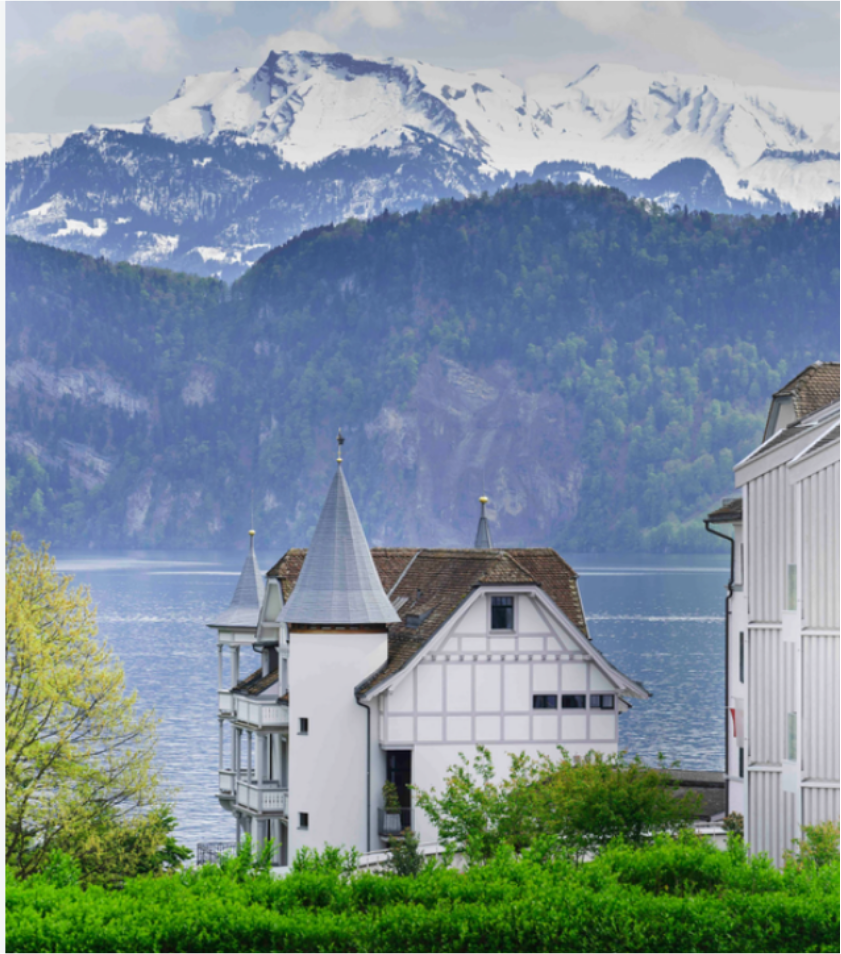
"You arrive on Lake Lucerne with Rigi and Pilatus in front of you and a private lakefront below, and you do not see the scale of what is behind it. The new guest wing is set back so you never read its size on approach. The medical spa, which is about five thousand square metres, is partly buried under gardens. You walk in past bonsai courtyards. The ceilings in parts of the spa are hand-carved and the forms come from forests, roots, water and fire. There is Swiss art throughout. Davide Macullo designed it between about 2018 and 2020, keeping the historic buildings and adding a timber wing, and he has talked about designing for people who might be physically or emotionally fragile during a week here. You can feel that. The building recedes. It does not try to impress you every five seconds, which is the opposite of what twenty thousand square metres usually does."
"Then the room, and the first thing I noticed was an absence. No minibar. No coffee machine. That reads like a small detail and it is the whole thesis. When the food is a prescription, the room cannot keep behaving like a hotel room."
"You do not choose treatments here. Treatments are only performed inside a valid programme, the core detox needs seven nights minimum, and your programme is set before you arrive and adjusted after a doctor sees you. The spa menu is not the centre of the experience. The programme is, and everything else is subordinate to it."
"And then the food, which is the part people will not believe. Approximately 850 calories a day. Not per meal. Per day, across three plant-based meals. Chenot describes it as fasting-mimicking, which is their term and I am leaving it as their term. What I can tell you is what arrives: stuffed sun-dried tomato gnocchi with basil pesto and almond cream, chickpea falafel with cucumber and dill, mushroom broth, lemongrass broth. Plated like a restaurant with no constraint at all. And you are sitting in one of the most beautiful hotels in Switzerland, looking at a lake, eating a portion of food that would be a starter anywhere else."
"Nobody should pretend this is comfortable. People get hungry here and they say so. The coffee goes and chicory arrives, and the caffeine withdrawal is reportedly one of the hardest parts for a lot of guests. There is something almost funny about paying this much to come to Switzerland and having one of your strongest memories be wanting a cup of coffee. That tells you more about the place than any paragraph about holistic wellness, which is a phrase I would like struck from this industry."
"The days have a rhythm because the treatments repeat. On the Advanced Detox week it is six energetic massages, six hydro-aromatherapy treatments, six phyto-mud treatments, six hydro-jets, with the medical consultations and diagnostics threaded through. You are not trying a mud wrap so you can say you did. You are doing it again on Thursday."
"The hydro-jet deserves its reputation. You are wrapped in warm mud in a five-star Swiss resort and then somebody directs a very forceful stream of cold water at you. A Forbes writer who stayed here compared it to being hit with a hose. Chenot calls it invigorating. Both descriptions are accurate and I prefer the first one."
"And the contrasts keep coming. Warm mud, then cold water. Cupping and meridian massage in the morning, a DXA scan in the afternoon. Three minutes in a chamber at about minus 110 degrees, then out to the lake. Chenot's own materials describe this as hormesis: challenge the body, raise sympathetic activity, then let it recover, over and over. I think that is the most useful way to understand the whole property. Controlled stress, then care."
"Now the part where I have to be careful, because I liked this place and that is exactly when you have to be hardest."
"There is a great deal here that is genuinely measured. DXA separating bone, lean tissue and fat. Breath-by-breath cardiorespiratory testing. Arterial stiffness. Advanced glycation end products. Minerals and heavy metals. Blood, urine and saliva. That is real infrastructure and it gives a doctor a baseline instead of a hunch."
"And sitting on the same menu is a Bio-Energetic Check-up using what they call Resonance Analysis Technology, which Chenot says reports the energetic state of organs and bodily functions. I am not going to write that sentence as though it were equivalent to a blood panel, because it is not, and nothing on the menu tells a guest which is which. That is the single thing costing them the most in this file, and the frustrating part is that they do not need it. The instruments they have already earned the credibility that the bioenergetic offering is borrowing."
"Same for the vocabulary. Detox is an enormously broad word and the body already metabolises and eliminates things continuously. If a specific substance or biomarker is being moved, name it. Biological age is becoming the most abused phrase in this industry. Autophagy is a real process and not a thing you can feel happening on a Tuesday. I am not saying any of it is false. I am saying it is being asserted at a confidence the evidence has not reached, inside a building full of instruments that could say something plainer and truer."
"What impressed me most, and what I do not think another hotel can buy, is that everything is connected. A Four Seasons could install a cryochamber tomorrow. It could buy a DXA scanner, an altitude room, red light beds, Technogym, a dietitian. None of that is the moat. The moat is that here the kitchen knows what the medical programme is trying to do, the diagnostics feed the consultation, the consultation shapes the treatment, the treatment schedule owns the day, the human performance department talks to the medical side, and the architecture is quietly lowering your stimulation the whole time. That integration is far harder to copy than any machine."
"One Bio Star, and I want to be precise about why, because the number will look low against how much I admired this place. The institutional score came out at 4.07, which is squarely in Two Star territory, and seven Circles cleared 4.0 where six are required. It is held at one star by the floor and by nothing else. Efficacy and Cultural Responsibility both landed at 3.43 against the 3.5 a second star needs. Seven hundredths of a point."
"So here is what I would say to them, and I mean it warmly. You are not one machine away from a second star. You are one publication away. You measure body composition, arterial stiffness, glycation, cardiorespiratory fitness and gene activity on every guest who walks through, and you publish none of it. Put the aggregated numbers out. Separate the one instrument that has not earned its place from the many that have. Do those two things and this file reads very differently, and I would be glad to be the one to rewrite it."
— Inspector 7
13-Circle Findings
Circle by Circle.
I · Core Integrity
Pass
The property is precise about what it does and looser about why it works. Programme inclusions, treatment counts, diagnostic panels, stay minimums and the calorie figure are all published plainly, which is more disclosure than this category usually offers. The words detox, bioenergetic, energy balance and biological age are the property's own, and this file attributes them to the property throughout rather than adopting them as the institution's.
II · Efficacy
Partial
The floor of this file, and the only thing standing between Chenot and a second star. The components carry real literatures: caloric restriction, exercise, sleep and circadian timing, hypoxic training and photobiomodulation are each genuine fields. The mechanisms are articulated more fully here than anywhere else in this volume. Practitioner infrastructure is the exemplar. What is missing is evaluation: the Chenot Method as delivered has not been assessed, the property publishes no outcome data, and the Bio-Energetic Check-up using what the property calls Resonance Analysis Technology sits on the same menu as the DXA scanner with nothing to tell a guest that one is validated and the other is not.
III · Physiological Alignment
Pass
Metabolic intelligence is the spine of the property. Body composition separated into bone, lean tissue and fat; cardiovascular and metabolic testing; arterial stiffness; advanced glycation end products; minerals and heavy metals. The dietary intervention is itself a metabolic instrument and the property measures what it does. The building was designed around guests who may be fragile during a week here, and behaves that way.
IV · Regulation & Recovery
Pass
Six hydro-aromatherapy treatments, six phyto-mud treatments, six hydro-jet treatments and six energetic massages in one week, with breathing sessions, hypoxic training and a dedicated sleep programme built on chronotype and circadian structure. Restoration is protocolised rather than offered. The honest deduction is that the programme deliberately imposes burden rather than reducing it, which the property states in advance and the institution records as a chosen cost.
V · Input Quality
Partial
Three plant-based meals of whole ingredients, plated to a standard that would not embarrass a restaurant with no constraint at all, and an equipment schedule chosen for the programme rather than the brochure. Food provenance, traceability and supplier documentation were not published and are open items.
VI · Environmental Quality
Pass
The strongest Circle in the file. Timber cladding, locally sourced natural materials, hand-carved ceilings drawn from forests, roots, water and fire, Swiss art throughout, light handled as a design material, and a spa laid under gardens. The architect's stated intention was not to overwhelm the senses, and the Inspectorate has not assessed a property that manages sensory load more deliberately.
VII · Operational Precision
Pass
Process is the property. The programme is selected before arrival, adjusted after medical consultation, and individual treatments are released only against a valid programme, so a guest cannot assemble a spa day here. More than one hundred specialists execute an individualised regimen daily. The Body Insights programme, which drops the detox diet entirely, is the clearest evidence that the property has learned and is willing to stop requiring every guest to fast.
VIII · Care & Competence
Pass
The hardest hospitality brief in this volume. The staff are caring for people who are hungry, withdrawing from caffeine, cold, tired, undergoing testing and anxious about results, and who are paying a great deal for the privilege. Doing that without breaking the discipline that causes it is a different skill from ordinary luxury service, and independent accounts describe it being met.
IX · Protocol Design
Pass
Seven nights minimum, six of each core treatment, and a day whose decisions are made for the guest. Friction is designed in and considerable, and it is purposeful and supervised. The reservation is trust architecture: credibility earned by genuine measurement is then spent on language the measurement does not support.
X · Aesthetic Restraint
Pass
The clearest case of subtraction in this volume. No minibar, no coffee machine, no alcohol, no caffeine, no unstructured time, approximately 850 kilocalories, and a guest wing set back so its mass is never read. The building is restrained. The vocabulary is not, and that is the one place the discipline lapses.
XI · Stewardship
Partial
Historic hotel buildings renovated rather than replaced, a new wing in timber, locally sourced natural materials, and a medical spa built partly beneath gardens so the landscape runs over it. No carbon figure and no energy or waste accounting published for a property of this size and clinical intensity.
XII · Cultural Responsibility
Partial
Tied for the floor. Traditional Chinese Medicine concepts including cupping and meridian-influenced massage are used in their own terms and credited rather than rebranded, which is the correct handling, and Henri Chenot and Davide Macullo are both named for their contributions. Historic buildings preserved, local materials, Swiss artists collected throughout. Labour practices, supplier relationships and community engagement are all undocumented, and whether a fifty-year-old European method that absorbed a tradition has kept it authentic is a question the Inspectorate leaves open rather than answering in the property's favour.
XIII · Enduring Value
Partial
Approximately fifty years of one method, in premises purpose-built in 2020 to carry it forward, through a decade in which this category chased every trend that passed. Against that, no outcome data is published for a property that measures body composition, arterial stiffness, glycation, cardiorespiratory fitness and gene activity, which is the clearest documentary gap in the file.
The Record
What was examined.
The property
Chenot Palace Weggis, on Lake Lucerne at Weggis, facing Rigi and Pilatus, with a private lakefront the property states guests may swim from throughout the year. Ninety-seven rooms. A medical spa of approximately 5,000 square metres. More than one hundred medical and wellness specialists across specialised disciplines. A metabolic and sports laboratory, a molecular laboratory, a whole-body cryotherapy chamber, an altitude room and a diagnostic panel running from dual-energy X-ray absorptiometry to epigenetic profiling. The scale is concealed rather than displayed, and that concealment is the design.
The building
Built and renovated between roughly 2018 and 2020 to a design by Davide Macullo Architects, across approximately 20,000 square metres, combining renovated historic hotel buildings with a new timber guest-room building, medical spa and wellness areas. Fifty-two rooms sit in the pre-existing buildings and forty-five in the new timber construction. The new wing is set back so its scale is not read on approach. The spa is partly concealed beneath gardens. There are bonsai courtyards, timber cladding on the newer portions, hand-carved ceilings in parts of the spa and communal areas drawn from forests, roots, water and fire, and a contemporary art collection of Swiss artists through the hotel, spa and guest rooms. Natural and locally sourced materials were used in the new construction.
Architecture as part of the treatment
The architect has described designing specifically for people who may be physically or emotionally vulnerable during a week-long programme, and the building behaves accordingly. Mass is withheld on approach. Transitions become more intimate as a guest moves inward. The palette stays controlled. The landscape reappears at intervals. Gardens run over the spa roof. The institution records this because wellness architecture usually means beige furniture and a water feature, and here the actual mass of the building, the sequence of spaces, the materials, the light and the proportions were decided around how a person should feel inside them. A building of twenty thousand square metres that does not feel like one is a considerable achievement.
The rooms, and what is missing from them
Wood floors, neutral furniture, soft colours, lake views depending on category, and nothing asking for attention. The detail the Inspectorate regards as most telling is an absence: no minibar and no coffee machine, as independently reported by a previous guest and confirmed on inspection. That reads as trivial and is not. When caffeine and outside food would interfere with a prescribed programme, the room itself has to stop behaving like a luxury hotel room. It is the precise point at which the hotel and the medical programme become the same building.
The programme is not optional wellness
A guest does not check in and then decide whether to book a massage. Individual treatments are performed only while following a valid programme. The core detox programmes require a minimum seven-night stay. The programme is selected before arrival and adjusted following medical consultation. That single rule changes the relationship between guest and property: the spa menu is not the centre of the experience, and the programme is.
The diet
The signature Chenot Detox Diet provides approximately 850 kilocalories per day, divided into three plant-based meals. Not per meal. Per day. The property describes it as a fasting-mimicking diet whose stated intention is to reproduce some of the physiological effects associated with fasting while still providing food. The Inspectorate records three things as fact: that guests receive approximately 850 kilocalories daily, that the food is plant-based, and that fasting-mimicking is the property's own description. Any broader claim that the diet detoxifies the body, activates a particular process to a clinically meaningful degree, reverses biological age or produces a specific health outcome is recorded as a CHENOT CLAIM and is not adopted here.
What 850 kilocalories looks like
Independent accounts describe the meals as colourful, plant-based and surprisingly nourishing despite the restriction, naming stuffed sun-dried tomato gnocchi with basil pesto and almond cream, chickpea falafel with cucumber and dill sauce, mushroom broth and lemongrass broth. Coffee is withdrawn for the duration of the detox programme and chicory offered in its place. Independent accounts report the caffeine withdrawal as among the hardest parts of the week for many guests. The Inspectorate records that a person can pay a great deal to come to one of the most luxurious health properties in Switzerland and leave with the memory of wanting a cup of coffee, and that this is more informative about the property than any account of its philosophy.
The hunger, unsanitised
Published first-person accounts describe hunger pains alongside caffeine-withdrawal symptoms as part of the challenge, and another guest described the experience as buying into severe food restriction delivered in extremely beautiful presentations. The institution does not soften this. Luxury here does not remove discomfort. It supports a person through it, which is a different proposition and a more interesting one.
The daily rhythm
Repetition is the structure. On the Advanced Detox programme the published materials list six Chenot Energetic Massages, six Hydro-Aromatherapy treatments, six Phyto-Mud treatments and six Hydro-Jet treatments across the week, with medical and nutritional consultations and diagnostic assessments threaded through. A guest is not trying a mud wrap in order to have tried one. They are doing it again on Thursday. That repetition is what makes Chenot read as a regimen rather than a spa.
Hydrotherapy, mud and the hydro-jet
Chenot describes Hydro-Aromatherapy as using essential oils alongside varied water temperatures and pressures, with a stated purpose related to circulation and lymphatic drainage, which is the property's own account of the mechanism. What can be described without qualification is the physical experience: water, temperature, pressure, and being moved directly from one treatment into the next. The phyto-mud treatment is warmth, weight and stillness, followed by a cold-water component that independent accounts describe as very intense. The hydro-jet has a reputation and earns it. A Forbes writer who stayed at the property described the high-pressure cold jet as extremely intense and compared the sensation to being blasted with a hose. Chenot calls it invigorating. Both accounts describe the same event. A guest who has just been wrapped in warm mud in a five-star Swiss resort is then subjected to a very forceful stream of cold water, and that sentence conveys more about this property than a paragraph of philosophy.
Cupping and the energetic massage
The Chenot Energetic Massage incorporates cupping and massage techniques influenced by Traditional Chinese Medicine, and independent guests name the cupping and meridian-style work as among the most memorable parts of the daily routine. The institution describes what physically happens and attributes the explanation. Where Chenot states that the treatment restores energetic balance, that is recorded as the property's language. The treatment can be excellent, and by independent report it is, without this file pretending every theoretical mechanism rests on the same foundation as a blood panel.
The Bio-Energetic Check-up
Chenot offers what it calls a Bio-Energetic Check-up using Resonance Analysis Technology, and states that the system provides information about the energetic state of organs and bodily functions relative to defined health parameters, after which treatment may incorporate acupuncture and other bioenergetic interventions. The Inspectorate records exactly what the property calls it and exactly what the property says it measures, and stops there. No evidence was located establishing this as equivalent to conventional validated medical diagnostics, and this file does not present it as such. This is the single item costing the property the most in the scoring, and the Inspectorate notes with some frustration that it is also the item the property needs least: the instruments in the room next door have already earned the credibility this one is borrowing.
The conventional diagnostics
Substantial and real. Blood, urine and saliva testing with biomarkers varying by guest and programme. Body composition by dual-energy X-ray absorptiometry, differentiating bone mineral density, lean tissue and fat tissue, which gives the medical team an actual baseline rather than an impression. Cardiovascular and metabolic testing. Breath-by-breath cardiorespiratory fitness assessment by the Human Performance Department, measuring how effectively the cardiovascular and respiratory systems transport oxygen during exercise. Nutritional and medical consultations. Postural and movement assessment. Arterial stiffness. Advanced glycation end products. Skin collagen thickness. Minerals and heavy metals. This is performance and diagnostic infrastructure of a seriousness the category rarely reaches, and it is not a Peloton in the corner of a hotel gym.
Altitude, cold and light
An altitude room in which guests exercise under reduced-oxygen conditions, with thirty-minute hypoxic training sessions included in the Body Insights programme. A whole-body cryotherapy chamber reaching approximately minus 110 degrees Celsius, with exposure lasting a maximum of around three minutes under medical supervision. Whole-body photobiomodulation using red and near-infrared light, for which Chenot makes claims around circulation, mitochondrial activity, pain, inflammation, mood and sleep. Neuro-acoustic deep relaxation treatments, which Chenot describes as using auditory and neuroscience-based signals intended to move the nervous system toward parasympathetic dominance. The institution records the existence and the specification of each, and attributes each stated benefit to the property rather than adopting it. Photobiomodulation and hypoxic training are both genuine research areas; that a field exists is not the same as a specific claim being established.
Hormesis, which may be the key to the whole place
Chenot's own materials describe deliberately challenging the body, increasing sympathetic activity and then allowing recovery, and connect this to hormesis. The Inspectorate regards that as the most useful frame for understanding the property. Controlled stress, then recovery, then controlled stress again, across a week. It explains the hydro-jet, the cryotherapy chamber, the calorie restriction, the hypoxic training and the cold water after the mud, and it explains why so much of the surrounding experience is devoted to making the recovery half of that cycle as comfortable as the stress half is not.
Epigenetics and the word to watch
Chenot operates what it calls the Molecular Lab for Optimal Living, which the property states uses epigenetic technology to analyse gene activity and biological aging status and to inform personalised recommendations. The institution records what is measured and declines the interpretation. Biological age is among the most abused phrases in contemporary wellness. Epigenetic clocks are a real and active area of research; different clocks give different answers on the same sample, their predictive value for an individual is weak, and no intervention has been shown to extend a human life on their basis. A file may say that a measurement was taken. It may not say that a guest was told how old their body really is.
Body Insights, and why it matters
The Body Insights and Optimisation programme runs five nights and four days and does not use the 850 kilocalorie detox diet at all, describing its diet instead as balanced and anti-inflammatory. Listed contents are eight diagnostic screenings, four functional tests, two medical consultations, one nutritional consultation, six movement, education and performance sessions and four therapies. The Inspectorate regards this as the single most encouraging thing in the file. A property built on a signature restriction protocol has separated intensive detox programming from a diagnostics and performance approach, and no longer requires every guest to fast. That is an institution revising itself, which is rarer than any machine.
Sleep
A dedicated Sleep Cycles programme structured around chronotype and circadian rhythm, incorporating diagnostics including heart-rate variability and stress testing alongside other Chenot screenings, and deploying photobiomodulation, neuro-acoustic relaxation and other interventions depending on programme. The question the institution asks of any property claiming sleep expertise is whether sleep is treated as infrastructure or as a pillow menu. Here it is infrastructure, with its own diagnostics and its own programme.
The lake
And then a guest walks outside. Lake Lucerne, the mountains, a private lakefront from which the property states guests may swim year-round, guided walks and hikes, tennis, yoga, outdoor movement. One of the more intelligent decisions at Chenot is that the technology never entirely displaces the landscape. A person can spend part of a day being measured by instruments and another part looking across the lake toward the Alps, and the institution regards both as part of the treatment whether or not a biomarker can be assigned to the second.
Service, and the hardest brief in hospitality
Independent accounts describe the service as extraordinarily attentive and discreet, and guests repeatedly describe staff across departments as unusually caring. One published account records a guest handing over an electric car on arrival and discovering on departure that staff had charged it without being asked. That is recorded here as an independently reported guest experience rather than the Inspectorate's own, and it is the right kind of example: not a phrase repeated fifty times, but someone noticing what was never requested. The institution records what this team is actually managing. Guests here are hungry. Some are withdrawing from caffeine. Some are tired, some are cold, some are mid-diagnosis and anxious about what the results will say. All of them are paying a great deal. Caring for a person without breaking the discipline that is making them uncomfortable is a fundamentally different skill from ordinary five-star service, and it deserves to be assessed as one.
What cannot be bought
A Four Seasons could install a cryotherapy chamber tomorrow. It could buy a DXA scanner, an altitude room, photobiomodulation beds, Technogym equipment and a dietitian. It could put mud on somebody. None of that is the moat. The moat is that here the guest's food is connected to the programme, the medical consultation is connected to the diagnostics, the diagnostics shape the treatment, the treatment schedule owns the day, the human performance department talks to the medical department, the kitchen understands what the medical programme is trying to accomplish, the architecture is deliberately reducing stimulation throughout, and the hospitality team is trained to support people through an experience designed to be difficult. Every part has to work with every other part. That integration is far harder to copy than any machine on the equipment list.
Where the institution pushes back
Detox is an extremely broad word, and the human body already possesses sophisticated systems for metabolising and eliminating substances continuously. Where a specific substance or biomarker is being moved, it should be named. The same caution applies to biological age, to bioenergetic medicine, to energy balance, to claims about reversing aging and to claims about autophagy. There is legitimate science around fasting and caloric restriction, around metabolism, exercise, sleep and circadian biology, and around several of the technologies in use here. It does not follow that every claim under one umbrella carries the same evidentiary weight. The Inspectorate states this plainly because saying so makes the award mean more, not less: a property that can withstand this much scrutiny and still hold its shape has been paid a compliment, not dealt an insult.
What the property gets right even if every debatable claim is set aside
Strip out every contested mechanism and a great deal remains. Chenot controls the environment. It controls the food. It creates time, which is the scarcest input in any health intervention. It removes alcohol and caffeine for the duration. It builds a repeatable daily rhythm. It measures a great many things with real instruments. It incorporates movement and trains it against measured fitness. It treats sleep and recovery as programmes rather than amenities. It puts guests in a landscape. It employs real medical personnel in numbers. It has built serious human performance infrastructure. It has made a physical environment that is intentionally calming at the level of mass, material and light. And it is willing to make a paying guest temporarily uncomfortable rather than optimising every moment of a luxury stay around pleasure. That last one is genuinely unusual, and it is most of the award.
How the tier was computed
Ninety-one sub-criteria were scored at the published anchors, where 3 meets the institutional standard, 4 exceeds it and 5 sets it. Circle I passed on all seven binary tests. One sub-criterion was recorded N/A, packaging safety, which has no subject in a residential programme. The twelve scored Circles averaged as follows. Environmental Quality 4.67. Regulation and Recovery, Care and Competence, and Aesthetic Restraint 4.57 each. Physiological Alignment and Operational Precision 4.29. Protocol Design 4.14. Input Quality 3.71. Stewardship and Enduring Value 3.57. Efficacy and Cultural Responsibility 3.43. The institutional score, the mean of the twelve, is 4.07. Under the Floor Principle the lowest Circle gates the tier. Two Bio Stars requires a floor of 3.5, an institutional score of 4.0 and at least six Circles averaging 4.0 or above. This file returns an institutional score of 4.07 and seven Circles at or above 4.0, clearing two of the three tests, and a floor of 3.43, missing the third by seven hundredths of a point. The institution records that distance precisely because it is so small and because closing it requires nothing architectural, culinary or clinical. Efficacy is held down by four sub-criteria scored at 3: evidence base, scientific integration, outcome consistency and clinical significance, every one of which turns on the absence of published results rather than on any observed failure. Cultural Responsibility is held down by undocumented labour, sourcing and community practice. Publishing aggregated outcome data, and separating the one unvalidated instrument from the many validated ones, would move Efficacy alone far enough to change the tier. This is the shortest road to a second star in the entire volume.
Open Items
What the file is waiting for.
Publish outcome data, which alone would change the tier
The property measures body composition by DXA, arterial stiffness, advanced glycation end products, cardiorespiratory fitness, gene activity and a full blood, urine and saliva panel, on every guest who completes a programme, across ninety-seven rooms and years of operation. Aggregated, anonymised results at arrival, departure and follow-up would be the single largest contribution any property in this category could make to its own credibility, and on this file's arithmetic it would move Efficacy far enough on its own to earn a second Bio Star.
Separate the bioenergetic offering from the validated diagnostics
The Bio-Energetic Check-up using Resonance Analysis Technology currently appears on the same menu as dual-energy X-ray absorptiometry and breath-by-breath cardiorespiratory testing, with nothing to indicate to a guest that these rest on different foundations. Presenting them in distinct categories, with a plain statement of what each is and is not, would cost the property nothing and would remove the single heaviest deduction in this file.
Independent evaluation of the method
A controlled or at minimum prospectively registered evaluation of a Chenot programme, conducted by a party without a commercial interest in the outcome. The independent record of the experience is extensive and largely favourable. The independent record of the effect does not yet exist.
Name what detox means here
Where a specific substance or biomarker is being moved, name it and publish the measurement. The property runs a minerals and heavy metals panel already, which means it is better placed than almost anyone to replace a broad word with a specific number.
State the limits of the epigenetic report
A written statement given to guests receiving epigenetic profiling, setting out what gene-activity and biological-aging measures can and cannot tell an individual, that different clocks disagree on the same sample, and that no intervention has been shown to extend a human life on their basis. The measurement is interesting and the interpretation is where the risk sits.
Publish the medical framing of the 850 kilocalorie diet
Seven days at this intake is a significant physiological intervention. The screening criteria, the contraindications, the monitoring during the stay and the guidance on who should not undertake it are presumably rigorous and are not published. Publishing them would demonstrate the seriousness the programme already has.
Food provenance and suppliers
Origin, grade and supplier documentation for a kitchen that is effectively dispensing a prescription, under confidential review if the property prefers.
Carbon and energy accounting
No figure is published for a property of approximately 20,000 square metres running a cryotherapy chamber, an altitude room and a 5,000 square metre medical spa. The building's own design, with renovated historic fabric, timber construction and a spa beneath gardens, suggests a favourable position the property is not currently able to claim.
Labour, sourcing and community documentation
Employment practices, supplier relationships and engagement with Weggis and the wider Lucerne community were not documented in the materials reviewed. Any of the three would lift Cultural Responsibility, which is tied for the floor of this file.
The relationship with the tradition
Traditional Chinese Medicine concepts are credited rather than rebranded, which is the correct handling and is noted with approval. A statement of how the property trains, sources and relates to practitioners of that tradition would let the institution score this on evidence rather than leave it open.
The Reading Room
Inside the Unredacted File.
The full 13-Circle rubric. The Inspector's complete notes. The Evidence behind every finding. Filed inside the Membership.
Apply for Membership →Continue the Archive